
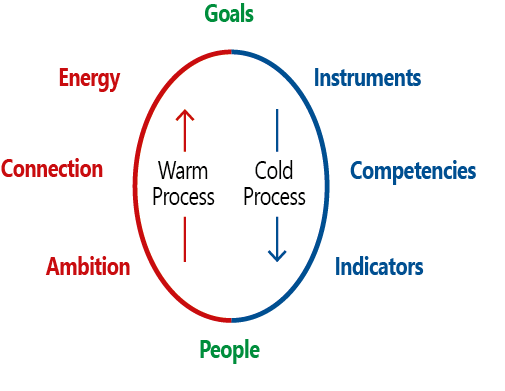
Cold organising
When you create a plan that requires people, you usually think of the following elements:
- Goals: What end result should activity deliver? Preferably as concrete as possible: Specific, Measurable, Acceptable, Realistic and Time-bound (SMART).
- Instruments: What resources do you need? What strategy do you want to follow? What are the steps by which you will implement the plan?
- Competencies: What do the people who are going to do it need to know and be able to do? And how do you make sure you get the people with the right competences together?
- Indicators: How will you measure whether you are making progress? What will you measure?
If all this is clearly agreed, then you hope people will start doing what is intended.
Good planning and structure provide clarity and security. They are also needed to nurture the confidence of those who have made space for the activity (money, permission, etc.).
Yet a good process that energises people does not start with this. This is why we call the structure side 'cold organising'. It usually costs more energy than it produces.
Warm organising
It starts with people with ideas coming together.
- People: Movement starts with people. Everyone has dreams, something they can get hot for. Although those desires can sometimes be covered under a lot of layers of fear.
- Ambitions: An ambition is a reason to take action, to get going. It is different from a goal: that is a visualisation of the end result.
- Connection: When people realise that they need others to fulfil their ambition, they seek connection.
- Energy: If it turns out that they share ambitions with each other, the hope grows that their actions can yield something of value. This generates energy.
People who set off with this energy become initiators who set goals and make plans. Connecting on ambitions and steering on energy is what we call 'warm organising'.
The tools on this site provide tools for this.